
The Use of Artificial Intelligence in Ayurveda: A Way Forward
In today’s rapidly advancing world, staying ahead requires continuous self-improvement. Upgrading involves enhancing or replacing something with a better version, whether it be skills, knowledge, or systems. Ayurveda, the ancient science of life, provides a holistic approach to health and personalised medicine, representing one of the oldest medical systems with thousands of medical concepts and hypotheses. Ayurveda is particularly noted for its ability to treat chronic diseases such as cancer, diabetes, arthritis, and asthma. To ensure the continued relevance and global appeal of this ancient medical system, it is crucial to integrate modern technology, particularly Artificial Intelligence (AI). AI, defined as the simulation of human intelligence by machines, especially computer systems, offers a promising avenue for upgrading Ayurveda.
While technology has long been recognised for its potential to reduce workloads, enhance storage capabilities, and save costs, its application in Ayurveda might seem incongruent to some. Ayurveda, often viewed as primitive and outdated compared to AI, which is seen as revolutionary and futuristic, might face resistance. However, by embracing digital technologies within the field of Ayurveda, we can usher in a transformative change that modernises this ancient practice.
Introduction
In the era of globalisation, Ayurveda has faced significant challenges in evolving to remain competitive in the international market. Historically, global brands have predominantly emerged from the West, but the world is now increasingly focusing on emerging markets like India, which boasts the second-largest consumer market globally. As consumers around the world become more aware of the harmful effects of chemicals in conventional medicines and beauty products, Ayurveda has gained widespread recognition for its natural, cost-effective therapies with minimal side effects. Despite this growing popularity, maintaining international standards of quality and competing with leading global brands remains essential for Ayurveda’s globalisation.
To achieve this, Ayurveda must embrace modern technologies such as Artificial Intelligence (AI). By integrating AI, Ayurveda can enhance its diagnostic and therapeutic capabilities, making it more accessible, credible, and appealing on a global scale. This paper explores the application of AI in Ayurveda and its potential to revolutionise this ancient system of medicine.
Aims and Objectives
The primary aim of this study is to examine the application and significance of Artificial Intelligence in the globalisation of Ayurveda. It seeks to understand how AI can enhance the practice of Ayurveda, enabling it to compete more effectively in the global market and meet the demands of a modern, tech-savvy audience.
Materials and Methods
The information presented in this study was gathered from a variety of sources, including web-based research and academic papers relevant to the intersection of AI and Ayurveda. The study focuses on the potential applications of AI in Ayurveda, as well as the challenges and opportunities associated with this integration.
Understanding Artificial Intelligence
Artificial Intelligence (AI) in computer science refers to the creation of intelligent machines that can perform tasks typically requiring human intelligence. This includes problem-solving, learning, reasoning, and understanding natural language. AI is a broad field with applications spanning various industries, including healthcare, where it has the potential to revolutionise traditional practices.
A Brief History of AI
The evolution of AI has been marked by significant milestones, beginning with its formal inception in 1956 at the Dartmouth College conference. However, the foundations of AI were laid a year earlier, in 1955, with the development of the first AI system, Logic Theorist, by Allen Newell and Herbert A. Simon. This system successfully proved nearly 40 theorems from Alfred N. Whitehead and Bertrand Russell’s Principia Mathematica, though the designers struggled to get it published.
AI has since evolved into a powerful tool with extensive applications in business, healthcare, engineering, and beyond. Despite concerns raised by notable figures like Professor Stephen Hawking about the potential dangers of AI, particularly regarding the future of humanity, the development of AI continues to accelerate. Today, AI is used in educational institutions, manufacturing firms, government offices, and research organisations, proving its versatility and potential to enhance various fields.
The Importance of AI in Ayurveda
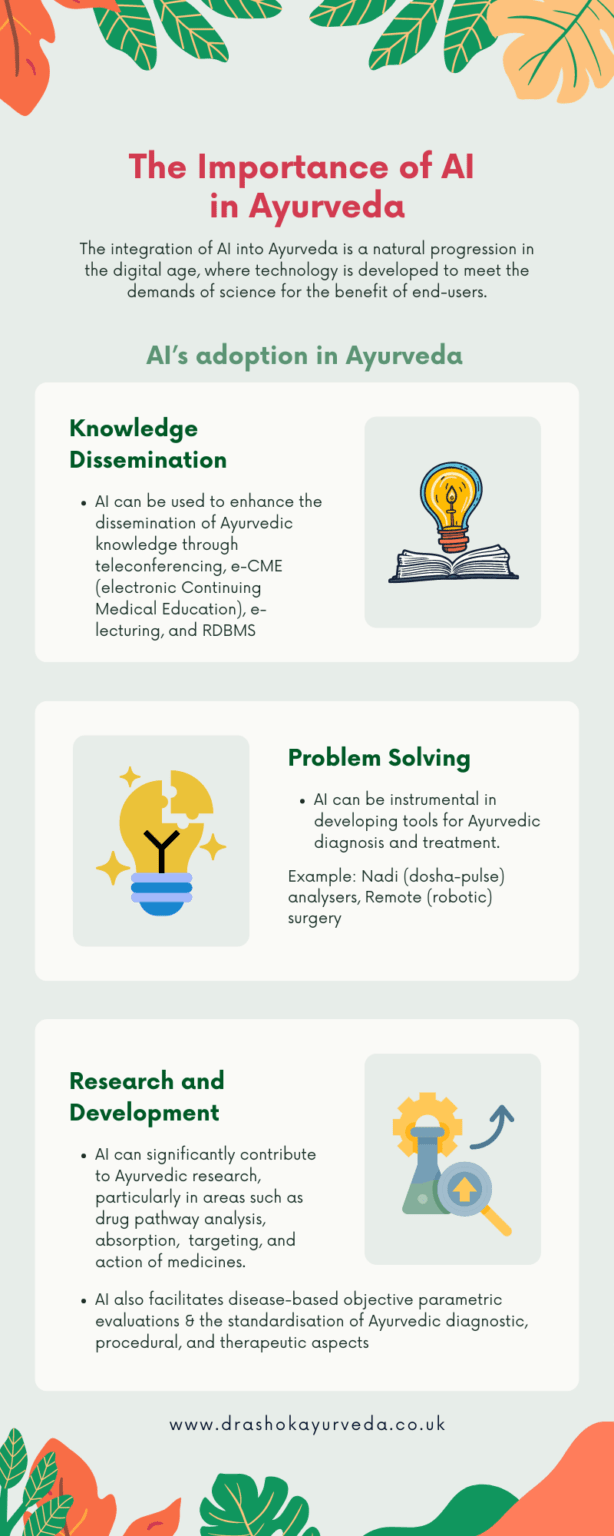
The integration of AI into Ayurveda is a natural progression in the digital age, where technology is developed to meet the demands of science for the benefit of end-users. AI’s adoption in Ayurveda is taking place in various forms, including knowledge dissemination, problem-solving, and research.
- Knowledge Dissemination: AI can be used to enhance the dissemination of Ayurvedic knowledge through teleconferencing, e-CME (electronic Continuing Medical Education), e-lecturing, and RDBMS (Relational Database Management Systems). These technologies allow for the broader sharing of Ayurvedic knowledge, enabling practitioners to stay updated with the latest advancements and best practices in the field.
- Problem Solving: AI can be instrumental in developing tools for Ayurvedic diagnosis and treatment. For example, AI-powered instrumentation for Ayurvedic diagnosis, such as Nadi (dosha-pulse) analysers, can provide more accurate and personalised diagnoses. Remote (robotic) surgery is another area where AI can enhance Ayurvedic practices, enabling minimally invasive procedures that align with Ayurvedic principles.
- Research and Development: AI can significantly contribute to Ayurvedic research, particularly in areas such as drug pathway analysis, absorption, targeting, and action of medicines. By leveraging AI, researchers can conduct disease-based objective parametric evaluations, leading to more precise and effective treatments. AI also facilitates the standardisation of Ayurvedic diagnostic, procedural, and therapeutic aspects, which is essential for global acceptance.
Applications of AI in Ayurvedic Diagnosis
Before implementing AI in Ayurveda, it is crucial to standardise diagnostic, procedural, and therapeutic methods. AI has already been applied in various research initiatives focused on Ayurvedic disease diagnosis through machine learning.
One example is Nadi Pariksha (Pulse Diagnosis), an ancient Ayurvedic technique that diagnoses physical, mental, and emotional imbalances through pulse readings. This non-invasive method is a scientific tool that enables personalised wellness regimes, including therapeutic massages, personalised diets, and detoxification. AI can enhance the accuracy and reliability of Nadi Pariksha by utilising artificial neural networks and decision trees to create tools that take VPK (Vata, Pitta, Kapha) pulse readings using optical sensors. These tools can detect the Prakriti (VPK) of the patient, covering the Sparshana phase of the three-fold Ayurvedic diagnosis.
Research has also explored the use of pressure sensors to detect pulse signals. For instance, AI-powered sensors can measure pulse amplitude, providing valuable data for diagnosing conditions such as anaemia and hyperacidity. By using advanced filtering techniques, AI can eliminate noise from pulse signals, leading to more accurate classifications of Vata, Pitta, and Kapha.
AI-Driven Innovations in Ayurveda
Artificial Intelligence is being increasingly integrated into Ayurveda, leading to the development of AI-driven diagnostic tools and systems that standardise and enhance Ayurvedic practices. These tools are based on vast datasets of Ayurvedic knowledge and patient treatment records, creating decision-support systems that aid practitioners in making root-cause-based diagnoses and offering personalised treatments. Such systems are crucial for making Ayurveda more credible and globally accepted, bridging the gap between traditional practices and modern healthcare demands.
Additionally, data mining is a key area where AI can significantly contribute to Ayurveda. Data mining, a computational process that uncovers patterns in large datasets, is essential for extracting valuable insights from the extensive knowledge base of Ayurveda. This process involves methods at the intersection of AI, machine learning, statistics, and database systems. The standardisation of Ayurvedic practices through data mining can lead to the development of AI-based tools for more accurate diagnosis and treatment, further enhancing the credibility and appeal of Ayurveda on a global scale.
One example of an AI-based system developed for traditional medicine is NIWARANA, implemented in Sri Lanka. NIWARANA provides users with access to information about Ayurveda doctors, a chatbot for interactive queries, and a sentiment analyser to evaluate doctor reviews. This system exemplifies how AI can enhance the accessibility and credibility of Ayurveda in the digital age.
Conclusion
Ayurveda, a system of medicine that originated in India, is now undergoing a modern transformation through the integration of Artificial Intelligence. This combination has made Ayurveda more high-tech, detailed, credible, and globally appealing in recent years. Given that Ayurvedic medicine is cost-effective with minimal side effects, AI can be leveraged to expand its market through e-commerce, significantly improving user experiences. Additionally, AI can enhance economic applications in Ayurveda, leading to cost reductions, revenue growth, and better asset utilisation. As Ayurveda continues to embrace AI, it stands to become a global leader in holistic and personalised medicine, blending ancient wisdom with cutting-edge technology for the benefit of humanity.